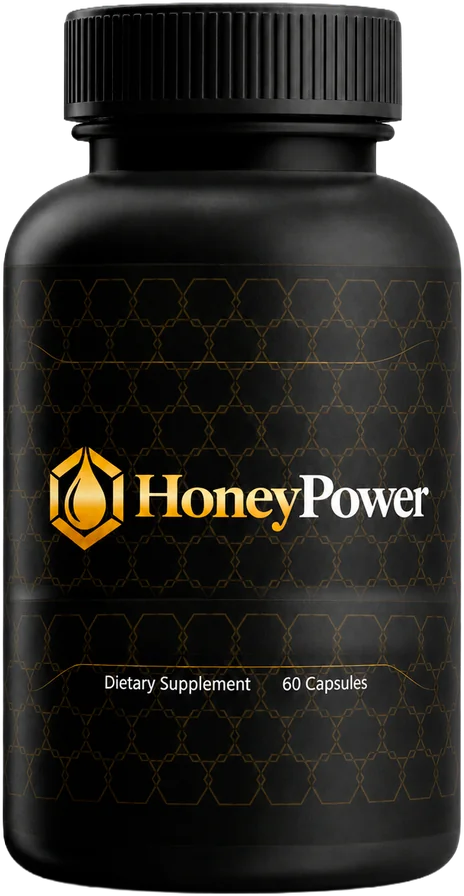
Bottle photo from HoneyPower's own checkout funnel, captured September 29, 2026. We digitally removed one line of on-label marketing wording before using this photo — the brand name, capsule count, and every ingredient disclosure elsewhere on the real label are untouched. See "The label, the funnel, and the photo we edited," below, for exactly what we removed and why.
- What it is: a capsule supplement, 60 capsules per bottle (thirty two-capsule servings), taken two capsules daily with water. The label lists no caffeine or other stimulant. Seven active ingredients: Tongkat Ali, Epimedium, saw palmetto, wild yam, sarsaparilla, nettle, and boron.
- What's changed since this product's earliest coverage: a real Supplement Facts panel now states a milligram amount for every one of the seven ingredients, and the listed return address moved from a post-office box in Utah to a street address in Largo, Florida. What hasn't changed: no distinct manufacturer company — no LLC, Inc., or comparable legal entity — appears anywhere in HoneyPower's own materials. The brand name itself, "HoneyPower," is also the name listed as the product's distributor.
- What we found checking the seller: the domain named in HoneyPower's own press materials serves a blank, unbranded placeholder page at its front door, while the actual sales page sits at a different web address reachable only through an affiliate-tracking link. A second, separate storefront domain is still an unfinished website-builder template whose own "buy" buttons feed into that same real sales page.
The formula, ingredient by ingredient — now with real numbers
Every one of HoneyPower's seven ingredients now carries a stated milligram amount on the Supplement Facts panel we inspected directly on the brand's own checkout funnel, for the label's two-capsule daily serving. That's a genuine change from where this product stood earlier in its short time on the market, when no public source — not the press announcement, not either storefront — disclosed an amount for anything. Two of the seven are listed as concentrated extracts with a stated ratio (for example, "100:1") and a corresponding claim about how much raw dried herb that extract is supposed to represent; that equivalency figure is the manufacturer's own stated conversion, not an amount we could independently verify. Two capsules also supply gelatin (the capsule shell itself isn't vegetarian, unlike some other supplements we've reviewed), microcrystalline cellulose, and magnesium stearate as fillers.
| Ingredient | Amount (per 2-capsule serving, per label) | What the research actually looks at |
|---|---|---|
| Tongkat Ali (Eurycoma longifolia) | 10mg, from a 100:1 extract — the label states this is equivalent to roughly 1,000mg of dried root powder | A small, four-week, placebo-controlled study gave a standardized root extract to 63 adults screened for moderate stress and reported improved mood-state scores and changes in several blood-based stress measurements versus placebo. It's a real, peer-reviewed result, but a single small trial in a general-stress population, not a study of this product, and we found no larger independent replication. |
| Epimedium (Epimedium sagittatum) | 8mg, from a 10:1 extract — the label states this is equivalent to roughly 80mg of dried herb powder | A flowering plant with a long history in traditional herbal practice. Laboratory and animal research has examined compounds it contains, but controlled human trials of the extract itself, taken on its own for general wellness use, are sparse. Findings from isolated cell or animal studies don't translate automatically into an effect in people taking a multi-ingredient capsule. |
| Saw Palmetto (Serenoa repens) | 20mg berry extract | The best-studied ingredient on this list, and not encouragingly. A 2006 randomized trial in the New England Journal of Medicine gave 225 men saw palmetto extract or placebo for a full year and found no meaningful difference between groups. A larger 2011 follow-up trial, escalating the dose to three times that amount in 369 men over 72 weeks, still found no benefit over placebo at any dose tested. |
| Wild Yam (Dioscorea villosa) | 20mg root extract | Wild yam contains a plant compound, diosgenin, that laboratory chemists can convert into other steroid-family compounds — but only through several deliberate processing steps developed decades ago. The human body has no equivalent enzyme pathway. Eating or supplementing with wild yam does not produce those lab-made compounds inside a person; this is a well-documented, generic point of confusion in the supplement industry, not something specific to HoneyPower. |
| Sarsaparilla (Smilax glabra) | 20mg root extract | A plant with a long history in traditional preparations. We found no large, controlled human trial testing a sarsaparilla extract on its own for the general wellness use case this product markets it for. |
| Nettle (Urtica dioica) | 20mg leaf extract | Worth flagging specifically: nettle research most often cited in this category uses the root, not the leaf, and studies that do exist generally test it in combination with saw palmetto rather than alone. HoneyPower's label specifies leaf extract, which puts it a step further from the research most commonly referenced for this ingredient. |
| Boron | 20mg, as boron amino acid chelate | See the finding below — this single serving equals the NIH's entire daily safety ceiling for this mineral. |
HoneyPower's own two-capsule daily serving supplies 20mg of boron. The NIH's Office of Dietary Supplements sets the tolerable upper intake level for boron — from every source combined, food and water included — at 20mg per day for adults. That means one day's serving of this product, by itself, uses the entire margin the NIH considers safe, before counting anything a person already gets from food or another supplement. HoneyPower's own September 26, 2026 press release makes a version of the same point, advising people who take multiple supplements to add up their combined boron intake — sound advice that's harder to act on if a buyer doesn't already know their daily serving of this one product sits at the ceiling on its own.
What we found checking the seller
HoneyPower's own press materials name honeypower.us as the brand's website. We loaded it directly on September 29, 2026: it serves a bare, unbranded page generated by a static-site template, its only visible content a single heading repeating the domain name back to the visitor. There's no product information, no company name, nothing else on it.
The page an actual buyer reaches is different. Clicking through HoneyPower's own order links routes through a tracking address at mwebtrackwise.com, which redirects to a fully built, separate page at honeypower.us/funnelb3/— a long-form sales funnel with a countdown timer, three package tiers, and a checkout handled by BuyGoods (payment account 13501). An affiliate-network pixel embedded in that page identifies the traffic source as MaxWeb (account 13605). In other words, the address printed in HoneyPower's own announcements shows visitors nothing, while the page that actually sells the product exists at a different location within the same domain, reachable only by following a tracking link.
A second, entirely separate storefront domain, honey-power.shop, is still exactly what earlier coverage of this product found it to be: a live website-builder template that was never finished. Checking its page source directly on September 29 turned up the same placeholder text reported before — "Add the exact ingredient name, form, amount and compliant description" repeated across its ingredient section, "Add your actual money-back guarantee, eligibility requirements, refund window and customer support contact" where a policy should be, and a footer instruction to "replace all example claims, prices and policies with verified store information before launch." Its own "Order Now" buttons, however, do work — they route through the same mwebtrackwise.com tracking link to the same real sales funnel described above. So the unfinished demo and the real, working checkout aren't separate problems; they're two doors into the same house.
Across everything we checked — the blank domain, the working funnel, the unfinished demo, both press releases, and the physical label — we found no distinct company name behind the brand. "HoneyPower" is listed as its own distributor, at a street address in Largo, Florida, with a phone number that's consistent everywhere it appears. BuyGoods, the payment processor, discloses on its own pages that acting as the retailer of record for a transaction isn't an endorsement, approval, or review of the product or any claim made about it.
The label, the funnel, and the photo we edited
The Supplement Facts panel and bottle graphic used on HoneyPower's real checkout funnel print a two-word marketing category directly on the label artwork, in large lettering between the brand mark and the capsule count — language stronger than the "men's wellness" framing HoneyPower otherwise uses in its own press releases and legal pages, and language this page's own editorial guidelines don't repeat verbatim. This is the same category of problem an earlier review of this product, on a different site in this network, found and corrected on an older version of HoneyPower's label photo: on-label wording baked directly into the graphic rather than appearing as separate, editable page text. Rather than skip the photo, we sampled the bottle's own repeating background pattern from a clean area of the same label and used it to digitally cover just that one line, the same technique used previously. The brand name, the capsule count, and everything on the separate Supplement Facts panel remain exactly as printed. For full transparency: that unedited Supplement Facts panel still prints an older common name for Epimedium elsewhere on the same label — not the marketing line we removed, but a genuine ingredient disclosure. We're calling that ingredient Epimedium throughout this page rather than repeating the vendor's label wording.
One more inconsistency worth noting: the physical label lists a support address at a domain called healthyconsumer.us, while HoneyPower's own September 26 press release lists a different support address at honeypower.us for the same phone number and mailing address. We can't tell you which one actually gets answered.
Two press releases, eight days apart, in two different voices
HoneyPower's initial launch announcement went out September 18, 2026 through a commercial wire service and was republished, word for word, across a network of regional news sites' syndicated wire sections — the same distribution pattern we've documented on other new product launches in this space. A second release followed on September 26, attributed to a "Kevin Moore, Product Head," specifically to publish the finished formula and label information. Its tone is markedly more careful than the sales funnel it supports: it explicitly separates "what the label identifies" from "what independent research has examined" from "what has actually been demonstrated for the complete formulation," walks through each ingredient's research with real hedges attached, and correctly states that a facility being FDA-registered is not the same thing as the FDA approving a dietary supplement. Read on its own, it's a genuinely more disciplined document than most manufacturer-issued marketing copy we see in this category.
What that even-handed tone doesn't disclose: nearly every link inside that press release — the ones reading "HoneyPower has published updated," "HoneyPower is also formulated without caffeine," "HoneyPower combines seven ingredients," and "HoneyPower is currently available to adult consumers" — doesn't point to honeypower.us at all. Each one routes through a tracking address at maxweboffers.com, the same MaxWeb affiliate network identified on the sales funnel itself. A document written and formatted like neutral consumer education is, underneath its own hyperlinks, a piece of affiliate-marketed sales collateral.
What the checkout page claims that we couldn't independently verify
The sales funnel we reached on September 29 displays a countdown timer reading roughly fifteen minutes remaining, paired with "Available Only While Supplies Last!" messaging; reloading the page resets the same countdown. It states that "94% of Customers" choose the six-bottle package. It displays three customer testimonials, each with a name, a city, a star rating, and a "Verified Purchase" badge, printed directly into the page's own source code rather than pulled from any outside, independently checkable review platform. We searched separately for an independent listing of this product — a Better Business Bureau profile, a Trustpilot page, anything comparable — and found none as of this writing. For a product whose earliest public documentation is eleven days old, we can't verify any of those specific figures, and a reader has no independent way to check them either.
The funnel separately states a 60-day, no-questions-asked, money-back guarantee, and describes the purchase as a one-time charge with no subscription or recurring billing. We have no basis to dispute either claim, but we also have no independent source confirming them beyond the seller's own page.
Pricing, as the checkout shows it
We aren't selling HoneyPower through this page, and nothing here is monetized — this is only what the seller's own checkout displayed on September 29, 2026, reproduced so the sections above make sense in context.
$79/bottle — 2 bottles, 60-day supply, $158 total, plus shipping
$69/bottle — 3 bottles, 90-day supply, $207 total, plus shipping
$49/bottle — 6 bottles, 180-day supply, $294 total, free shipping, plus three digital bonus guides
Each tier is also shown against a struck-through "compare" total — $298, $447, and $894 — that works out to exactly $149 per bottle in every case. The per-bottle math on the actual charged price is internally consistent with the totals shown. What we couldn't find anywhere, on either press release or either storefront, is any independent record that $149 a bottle was ever a real price this product sold for; it functions as a comparison number the seller set, not a documented former price.
This is the seller's own checkout pricing, not an Amazon link. Modern Biology News doesn't process this purchase, doesn't control this pricing, and earns nothing from it.
A plainly-labeled way to look at the one ingredient with a hard safety number attached
If the boron finding above is what caught your attention, NOW Foods Boron 3mg is a standalone way to look at that specific mineral without the rest of HoneyPower's seven-ingredient formula attached. It's a single ingredient at a fraction of HoneyPower's dose — 3mg per capsule against HoneyPower's 20mg per two-capsule serving — sold under an ordinary, findable manufacturer with a standard Supplement Facts panel and no bundled botanicals to account for. Research on boron in general remains limited, as discussed above; this isn't a recommendation that boron supplementation does anything in particular, only a transparently labeled option for anyone who wants to examine that one ingredient on its own, at a dose that leaves obvious room under the NIH's daily ceiling.
See it on Amazon →As an Amazon Associate, Modern Biology News earns from qualifying purchases. This link opens a live Amazon search for this exact product, not one listing we control — prices and sellers may vary.
Questions we got asked directly
Does the research behind these seven ingredients mean HoneyPower works?
It means each ingredient has its own, separate research trail, of very different strength and quality. Saw palmetto's is the largest and the least encouraging — two big trials found no effect over placebo. Tongkat Ali and boron each have one small, real study attached, neither designed to test this product. HoneyPower's own September 26 press release makes essentially this same point: individual-ingredient research doesn't establish anything about a seven-ingredient combination taken at these specific amounts, and we found nothing that closes that gap.
Why does the website look different depending on which link you click?
Because there isn't one HoneyPower website. The domain named in the company's own announcements shows a blank placeholder. A separate demo-template domain is unfinished. The actual sales page sits at a third location, reachable only through an affiliate-tracking redirect. All the "buy" buttons on every version eventually reach the same real checkout — but a visitor typing the brand's own domain directly, without a tracking link, sees nothing.
Is HoneyPower a scam?
We can't speak to intent. What we documented — a company name that resolves to no distinct legal entity, a blank "official" domain next to a fully built sales funnel reachable only via tracking link, an unfinished second storefront whose buttons still work, testimonials that aren't independently checkable for a product that's been on the market for eleven days, a press release whose neutral-sounding links are all affiliate-tracked, and a boron dose that by itself reaches the NIH's daily safety ceiling — is the pattern we'd want a reader to weigh before ordering.
Why link to a different product instead of HoneyPower?
Because HoneyPower's formula combines seven ingredients at once, at manufacturer-stated extract-equivalency ratios we can't independently verify, from a company with no findable legal identity. A single, plainly labeled ingredient from an ordinary manufacturer at least lets a reader examine one variable at a time.
HoneyPower's own checkout funnel at honeypower.us/funnelb3/, its honeypower.us root domain, and the separate honey-power.shop storefront, all checked directly on September 29, 2026, for label content, pricing, and page structure. HoneyPower's September 18, 2026 launch announcement, distributed via a commercial wire service and syndicated across regional news sites (Middletown Life, story 697572). HoneyPower's September 26, 2026 follow-up formula and label announcement, same distribution pattern (Middletown Life, story 711321). BuyGoods' own published disclaimer regarding its role as payment processor. Bent S, Kane C, Shinohara K, et al. Saw palmetto extract compared with placebo in a randomized trial of 225 men. New England Journal of Medicine, 2006. Barry MJ, et al., for the CAMUS Research Group, a NIH-funded randomized trial of escalating saw palmetto doses in 369 men. JAMA, 2011. Talbott SM, Talbott JA, George A, Pugh M, a placebo-controlled study of a standardized Tongkat Ali extract in 63 adults screened for moderate stress. Journal of the International Society of Sports Nutrition, 2013. Naghii MR, et al., a small pilot study of boron supplementation reporting blood-based inflammation and mineral-metabolism measures. Journal of Trace Elements in Medicine and Biology, 2011. NIH Office of Dietary Supplements, Boron — Health Professional Fact Sheet, for the tolerable upper intake level cited above. NOW Foods' own product labeling for the alternative discussed above. General background on wild yam and diosgenin chemistry draws on the broader pharmacognosy literature summarized for a general audience, not any single study.
This article is for general educational purposes and is not intended to diagnose, treat, cure, or prevent any disease. It is not a substitute for professional medical advice. Talk to a healthcare provider before starting any new supplement, especially if you take prescription medication or manage an existing health condition. Statements about dietary supplements have not been evaluated by the Food and Drug Administration.