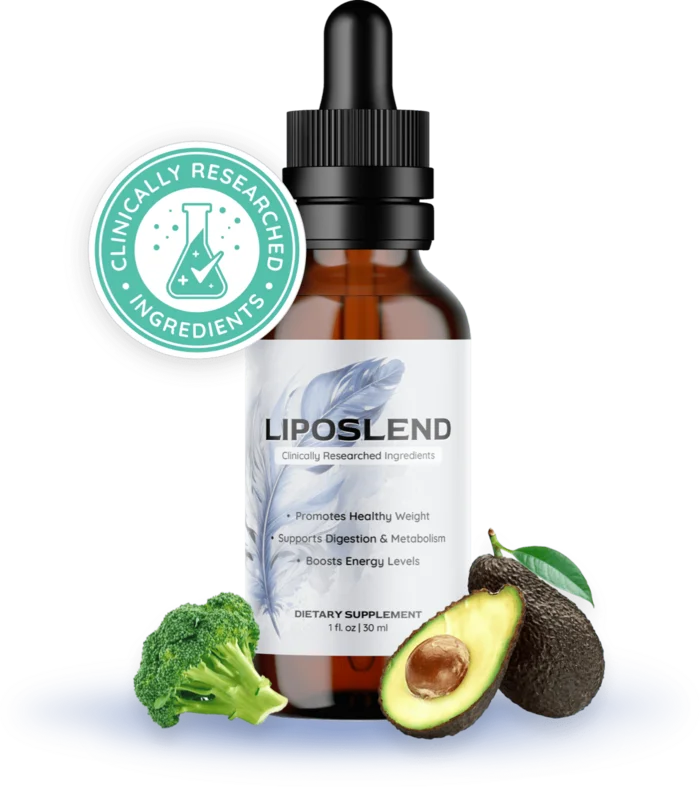
Product photography from Lipo-Slend's own marketing pages. Promotional badges shown in the image are the seller's, not something we're endorsing.
- What it is: a liquid supplement taken as drops under the tongue — the seller's own instructions call for a full dropper once daily, held for 30–60 seconds before swallowing, ideally before breakfast. A bottle is described as a 30-day supply.
- What the label leaves out: the six ingredients are named, but no version of the product page or bottle copy we could find discloses a milligram amount for any single one of them — so there's no way to check the formula against the doses used in the research behind each ingredient.
- What we found checking the seller: more than a dozen near-identical marketing domains, a flagship domain that runs a visitor-profiling and ad-blocker-detection script before deciding what page to show, and checkout handled by a third-party processor whose own stated refund window doesn't match the seller's.
The biology, ingredient by ingredient
Weight-management supplements usually lean on one headline ingredient. Lipo-Slend's approach is different: six compounds, each with its own separate line of research, combined into one liquid. That's worth taking seriously on its own terms rather than dismissing outright — so we looked at what each ingredient is actually studied for, separate from what the bottle claims for the blend as a whole.
| Ingredient | What the research actually looks at |
|---|---|
| Sulforaphane (broccoli sprout extract) | A compound that activates the NRF2 antioxidant pathway; animal and cell studies tie it to upregulation of proteins involved in fat oxidation and thermogenesis. Human trials exist for glucose metabolism and inflammation; direct human weight-loss data specifically is thinner. |
| Cissus quadrangularis | A plant extract with some of the better human evidence in this list — small controlled trials using a standardized extract (often labeled CQR-300) at around 300mg daily found reduced body fat and waist measurements in overweight participants over 8–10 weeks. |
| Acetyl L-carnitine | Its biochemical role — ferrying fatty acids across the mitochondrial membrane so they can be used for energy — is well established. A meta-analysis covering 37 randomized trials found modest, inconsistent effects specifically on body weight. |
| Beet root extract | Studied mainly for the dietary nitrates it supplies, which the body converts toward nitric oxide; most of that research is about blood flow and exercise performance, not weight loss directly. |
| Pine pollen extract | Long used in traditional preparations; controlled human evidence for any weight-related outcome is limited, and most of what's published is preclinical. |
| Glucomannan | A viscous soluble fiber from konjac root, arguably the single best-evidenced ingredient in this blend for modest, real weight-management support — but only at the doses used in that research, discussed below. |
Glucomannan's human evidence comes from gram-scale doses — commonly one to a few grams, taken with water, often before meals, because the fiber needs to absorb water and bulk up to do what it's studied for. A full dropper of liquid is roughly a milliliter. Bulk soluble fiber and a one-milliliter liquid dose are hard to reconcile: there isn't a disclosed amount to check the math against, but the format itself makes it unlikely this bottle is delivering gram-scale glucomannan. That doesn't necessarily apply to the other five ingredients, which are typically dosed in milligrams rather than grams — but it's the ingredient with the strongest human data, and the one the delivery method seems least suited to.
What the bottle doesn't tell you
Across the seller's own sales pages, the ingredient list is consistent — the same six names appear everywhere we checked. What's consistently absent is a supplement-facts-style breakdown showing how many milligrams (or, for glucomannan, grams) of each ingredient is actually in a daily dropper. Without that, a reader can't line the product up against the specific studies cited above, only against the ingredient names in general. We also couldn't locate a certificate of analysis for a finished bottle, or a named manufacturing company — the marketing pages describe the product as made in an "FDA-approved, GMP-certified facility" in the United States, without naming the facility or the company that operates it.
The storefront situation
Lipo-Slend isn't sold from one stable web address. Searching for where to actually buy it turned up well over a dozen near-identical domains — variations built around the product name with hyphens, extra letters, region prefixes, and different top-level extensions, each running the same sales page template. Checking the flagship lipo-slend.com domain directly showed something more specific: rather than serving a normal page, it loads a script that profiles the visitor's browser (checking for ad blockers, reading device, timezone, and location signals) and reports back to a third-party ad-routing service before deciding what to display. That's a pattern associated with affiliate traffic arbitrage — sending different visitors to different landing pages based on who and where they are — rather than what a single, stable brand storefront typically does.
Checkout, on the versions we could trace through, runs via BuyGoods, a third-party order processor. BuyGoods' own published policy describes a standard 30-day, no-questions-asked refund window across the products it processes, while Lipo-Slend's own FAQ pages describe a 60-day guarantee "assured by the manufacturer." Those aren't necessarily in conflict — sellers can and do offer longer terms than their processor's baseline — but it means a buyer needing a refund is relying on the seller's word for the extra 30 days, not the processor's standard policy.
Guarantee and pricing, as the seller shows it
We aren't selling Lipo-Slend through this page, and nothing here is monetized — this is only what the seller's own pages show, reproduced so the sections above make sense in context.
$69/bottle — 1 bottle, 30-day supply, plus shipping
$59/bottle — 3 bottles, 90-day supply, free shipping, plus two bonus items
$49/bottle — 6 bottles, 180-day supply, free shipping, plus two bonus items
The stated guarantee window is 60 days from purchase, refundable by contacting the seller, on condition the order came from the "official" site. Given how many domains present themselves as official, confirming you ordered from a page the seller will actually honor is a real, separate step — not a formality.
This is the seller's own checkout pricing, not an Amazon link. Modern Biology News doesn't process this purchase, doesn't control this pricing, and earns nothing from it.
A transparently-dosed way to look at the strongest ingredient
If the glucomannan research above is what interests you, NOW Supplements Glucomannan (Konjac Root) is a standalone way to examine it without the storefront questions documented above. It isn't trying to replicate Lipo-Slend's six-ingredient blend — it's konjac-root glucomannan on its own, disclosed at 575mg per capsule, in a bottle that lets you actually reach the gram-scale intake the human research on this fiber used by taking it as directed with water before meals. Disclosing an exact per-capsule milligram amount is more than either version of Lipo-Slend's label gives you for any of its six ingredients. NOW is a supplement manufacturer with a findable, ordinary company identity and distribution across established retailers, which is more than we could confirm for whichever entity currently operates Lipo-Slend's checkout.
See it on Amazon →As an Amazon Associate, Modern Biology News earns from qualifying purchases. This link opens a live Amazon search for this exact product, not one listing we control — prices and sellers may vary.
Questions we got asked directly
Does the research behind these six ingredients mean Lipo-Slend works?
It means each ingredient has a real, separate research trail in metabolic-health science, of varying strength. It doesn't mean this specific liquid blend, at whatever doses it actually contains, has been tested and shown to reproduce those results. The label doesn't disclose enough for a reader to check that gap themselves.
Why does the liquid-drop format matter?
Because at least one ingredient in the blend — glucomannan — is a bulk soluble fiber whose human evidence comes from gram-scale doses taken with water. A dropperful of liquid is a very different volume and delivery method than what that research used, and the label doesn't give a number to check against.
Is Lipo-Slend a scam?
We can't speak to intent. What we documented — no disclosed per-ingredient doses, an unnamed manufacturer, well over a dozen near-identical marketing domains, a visitor-profiling script on the flagship domain, and a guarantee window that exceeds its own payment processor's standard policy — is the pattern we'd want a reader to weigh before ordering.
Lipo-Slend's own marketing pages and mirror domains, checked directly for ingredient claims, serving instructions, pricing, and guarantee language, including a direct check of the flagship domain's front-end script behavior. BuyGoods' published refund policy. Preclinical and clinical research literature on sulforaphane and NRF2-linked metabolic pathways, on Cissus quadrangularis extract trials in overweight participants, on L-carnitine meta-analyses for body weight outcomes, on dietary nitrate research, and on glucomannan's clinical dosing in weight-management studies, summarized for a general audience rather than any single study. NOW Supplements' own product labeling for the alternative discussed above.
This article is for general educational purposes and is not intended to diagnose, treat, cure, or prevent any disease. It is not a substitute for professional medical advice. Talk to a healthcare provider before starting any new supplement, especially if you take prescription medication or manage an existing health condition. Statements about dietary supplements have not been evaluated by the Food and Drug Administration.