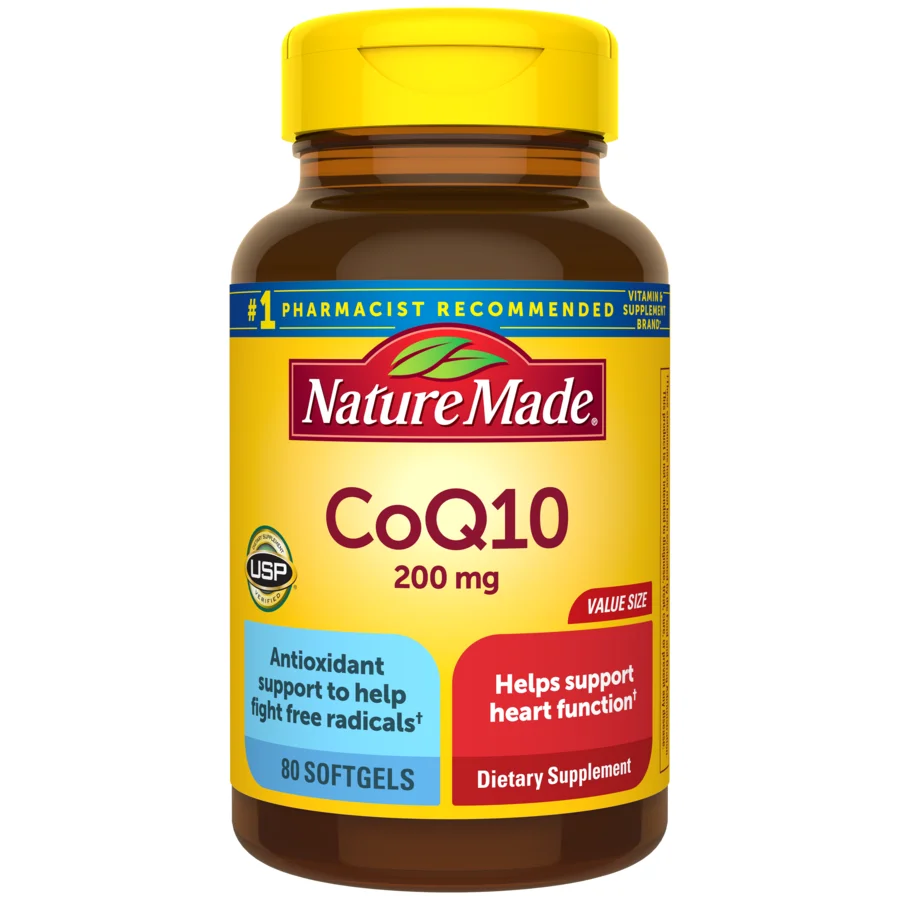
Official product photography, Nature Made / Pharmavite.
Nature Made CoQ10 200 mg Softgels
CoQ10 (coenzyme Q10) is a compound your own cells make and use inside mitochondria to produce energy. Nature Made's CoQ10 200 mg Softgels are one of the most widely purchased CoQ10 supplements on Amazon — a plain, single-ingredient softgel from a mainstream U.S. supplement brand (Pharmavite). Below is what the underlying biology actually says, what the USP Verified Mark on the label does and doesn't mean, and what the research supports and doesn't.
As an Amazon Associate, Modern Biology News earns from qualifying purchases. Price and softgel count vary by pack size — see the Amazon listing for current details.
What CoQ10 actually does inside a cell
Almost every cell in your body relies on mitochondria to convert food and oxygen into usable energy, in the form of a molecule called ATP. That conversion happens along a sequence of proteins embedded in the mitochondrial membrane called the electron transport chain. Coenzyme Q10 is one of the few non-protein components of that chain: it physically shuttles electrons between two of the chain's protein complexes, a step the whole process depends on. Without enough CoQ10 in the membrane, that handoff slows down, and so does ATP production.
CoQ10 has a second, separate job: in its reduced form (ubiquinol), it acts as an antioxidant inside cell membranes and in circulating lipoproteins, helping limit oxidative damage to fats. Both roles are well established in basic biochemistry — this isn't a disputed mechanism, it's textbook mitochondrial physiology.
The body makes most of the CoQ10 it needs on its own, and also gets a small amount from food (organ meats, fatty fish, whole grains, and some nuts). A supplement doesn't introduce a new function — it adds to a pool your cells are already producing and using continuously.
Why CoQ10 levels drop — the statin connection
CoQ10 production shares an early manufacturing step with cholesterol production, in a pathway called the mevalonate pathway. Statin medications work by blocking an enzyme early in that same pathway to lower cholesterol — and because the pathway is shared, statins can also lower the body's own CoQ10 production as a side effect of how they work, not because of anything wrong with the drug. This is a documented pharmacological mechanism, published by the NIH's Office of Dietary Supplements among other sources, and it's the most commonly cited reason a clinician might suggest a CoQ10 supplement specifically to someone on long-term statin therapy. It is a mechanism, not a guarantee of a noticeable effect — see the research section below.
CoQ10 levels also decline gradually with age, independent of any medication, which is the other commonly cited rationale for supplementing later in life.
Ubiquinone vs. ubiquinol — which form is this
CoQ10 exists in two interconvertible forms: ubiquinone (oxidized) and ubiquinol (reduced). This specific product — Nature Made's standard "CoQ10" line — uses ubiquinone, the more common and less expensive form found in most mainstream supplements. Nature Made separately sells a "Ubiquinol CoQ10" line at a higher price point. Some research suggests ubiquinol may absorb somewhat better in older adults, whose bodies convert ubiquinone to ubiquinol less efficiently, but the evidence comparing the two forms head-to-head in healthy adults is limited and mixed — it's not a settled "one form is clearly better" finding, and the standard ubiquinone form remains the more extensively studied of the two over a longer track record.
What "USP Verified" on this label actually certifies
Nature Made's CoQ10 200 mg Softgels carry the USP Verified Mark — we confirmed this specifically for this product and dosage against Nature Made's own product page and multiple retailer listings, rather than assuming it applies brand-wide (Nature Made makes hundreds of SKUs, and not every one carries the mark). Here's precisely what that verification does and doesn't mean:
| USP Verified confirms | The softgel contains the ingredients on the label, in the declared amount (200 mg CoQ10); it doesn't contain harmful levels of specified contaminants; it will dissolve and release its contents within a set time; and it was manufactured under FDA current Good Manufacturing Practices in a USP-audited facility. |
|---|---|
| USP Verified does not confirm | That the product treats, prevents, or improves any specific health condition. USP verification is a quality-and-manufacturing audit, not a clinical-efficacy claim, and it isn't an FDA approval — dietary supplements aren't FDA-approved the way drugs are. |
In practical terms: the USP mark is a reasonable signal that what's on the label is actually in the softgel and was made cleanly. It says nothing about whether taking it will produce a noticeable effect for a given person — that's a separate question, addressed below.
What the research does and doesn't support
Researchers have studied oral CoQ10 supplementation in a few specific contexts: whether it eases the muscle discomfort some people report on statins, whether it affects measures of heart function in people already being treated for a diagnosed cardiac condition, and whether it has any measurable effect on exercise performance or perceived energy in generally healthy adults. The pattern across that research is uneven — some trials, mostly in patients with a diagnosed condition and under a doctor's care, report a modest benefit on the specific measure being tracked; other trials, particularly in healthy adults without any diagnosed deficiency, find little to no measurable difference from placebo. The NIH Office of Dietary Supplements summarizes the overall evidence as promising in some patient populations but inconsistent and not conclusive for general, healthy-adult use.
What that means practically: someone with a clinician-identified reason to supplement — long-term statin use, a diagnosed cardiac condition under treatment, or a measured deficiency — has a more specific case for a possible benefit than someone without one. A generally healthy adult taking it hoping to simply "feel more energetic" day to day is supplementing on a much thinner evidence base, and shouldn't expect a dramatic or guaranteed effect.
On the label
| Active ingredient | Coenzyme Q10 (ubiquinone), 200 mg per softgel |
|---|---|
| Other ingredients | Soybean oil, gelatin, glycerin, water, soy lecithin (no artificial color — the orange tint is CoQ10's natural color) |
| Suggested use | One softgel daily with water and a meal. CoQ10 is fat-soluble, so absorption is generally better taken alongside food that contains some fat, rather than on an empty stomach. |
| Allergen note | Contains soy. Gluten-free per the label; always check the specific bottle and lot, since formulations can change. |
Who should talk to a doctor before starting this
CoQ10 is generally well tolerated, but it has one interaction worth knowing about: because CoQ10 is structurally related to vitamin K, it can reduce the effectiveness of warfarin and other vitamin K–dependent blood thinners. Anyone on a blood thinner should not start a CoQ10 supplement without checking with the prescribing clinician first. The same goes for anyone pregnant, nursing, or managing a diagnosed medical condition on other medication — a quick conversation with a pharmacist or doctor is the right move before adding any new supplement, not a formality to skip.
What's genuinely solid here
- USP Verified for this specific SKU — independent third-party check on identity, potency, and contaminants
- Single, simple ingredient at a clearly labeled, commonly studied dose (200 mg)
- Established, mainstream manufacturer (Pharmavite) with consistent GMP manufacturing
- Real, well-understood biological rationale (mitochondrial electron transport)
What to keep in perspective
- Evidence for a noticeable effect is strongest in people with a specific clinician-identified reason to take it — thinner for general healthy-adult use
- Uses the less expensive ubiquinone form; possibly less relevant for older adults if absorption is a specific concern
- Interacts with warfarin and similar blood thinners — not a supplement to start without checking first if you're on one
- USP Verified is a manufacturing/quality check, not a claim about health outcomes
As a manufacturing and quality bet, this is a reasonable, well-made version of a genuine, well-studied compound — the USP Verified Mark on this specific SKU is a real, meaningful third-party check, not marketing language. As a biological bet, whether you'll notice anything depends heavily on why you're taking it: the case is more specific for people on long-term statins, older adults, or anyone acting on a clinician's recommendation, and considerably thinner for a healthy adult hoping for a general energy lift. Either way, it's worth a short conversation with a doctor or pharmacist first, especially if you take a blood thinner.
This article is for general educational purposes and is not intended to diagnose, treat, cure, or prevent any condition. It is not medical advice. Talk to a healthcare provider before starting any new supplement, especially if you take prescription medication.
NIH Office of Dietary Supplements — Coenzyme Q10: Fact Sheet for Health Professionals.
United States Pharmacopeia (USP) — USP Verified Mark: criteria for identity, potency, purity, and dissolution testing.
Nature Made / Pharmavite — CoQ10 200 mg Softgels product labeling and USP Verified listing.
Federal Trade Commission — Guides Concerning the Use of Endorsements and Testimonials in Advertising (16 CFR Part 255), applicable to the affiliate link above. See our Affiliate Disclosure.