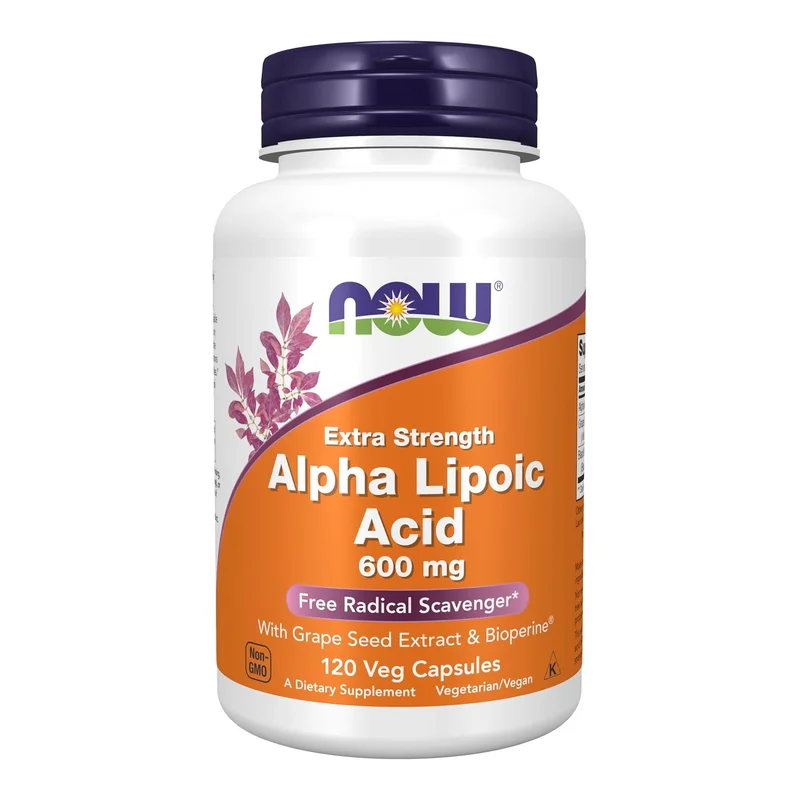
NOW Foods Alpha Lipoic Acid 600 mg: What This Antioxidant Actually Does in a Cell
A label-first look at NOW's Extra Strength Alpha Lipoic Acid capsules — the real dose, the racemic-vs-R-ALA distinction most product pages skip entirely, what's actually certified versus simply claimed, and the mitochondrial biology underneath the marketing.
Alpha lipoic acid (ALA) is one of the few supplement ingredients that isn't a plant extract, a vitamin, or a novel synthetic compound — it's a molecule your own mitochondria already make and use, in small amounts, every day. That makes it an unusually good case study for what a "cellular antioxidant" claim actually means biologically, separate from whatever a bottle's front label says. NOW Foods' Extra Strength Alpha Lipoic Acid is one of the more widely sold versions of this ingredient on Amazon, so we pulled the real Supplement Facts panel, checked what NOW's own certifications do and don't cover, and looked at what the underlying cell biology actually supports.
What Alpha Lipoic Acid Actually Is
Alpha lipoic acid is a small sulfur-containing fatty acid compound synthesized in small quantities inside human mitochondria, where it functions as a cofactor — a required helper molecule — for several enzyme complexes involved in converting food into usable cellular energy, including pyruvate dehydrogenase, one of the central gatekeeper enzymes of carbohydrate metabolism. In other words, before it's ever sold as a supplement, ALA already has a defined, well-established job inside your cells' energy-production machinery.
Separately from that metabolic role, free ALA and its reduced form, dihydrolipoic acid, also act as antioxidants — molecules that neutralize reactive, unstable byproducts of normal cell metabolism (broadly called reactive oxygen species) before they can damage proteins, lipids, or DNA. What makes ALA unusual among antioxidants is that it's amphipathic: soluble in both water and fat. Most antioxidants work well in one cellular environment or the other — vitamin C is water-soluble and works in the cell's watery interior, vitamin E is fat-soluble and works in cell membranes — but ALA can operate in both compartments, which is part of why cell-biology researchers have studied it as a distinct case from either one.
ALA's other well-documented mechanism is regenerating other antioxidants after they've been "used up" neutralizing a free radical. Laboratory and cell-culture research going back to foundational work by Lester Packer's group in the 1990s describes ALA and dihydrolipoic acid helping to recycle oxidized vitamin C, vitamin E, and glutathione back into their active, reduced forms — sometimes referred to as the "antioxidant network" concept. This is a real, mechanistically described process at the cell-culture and biochemical level; it is not the same thing as a clinical claim that taking an ALA capsule measurably changes a specific health outcome in a human trial, and we're not presenting it as one.
What's Actually on This Label
The product photographed and reviewed here is NOW Supplements, Alpha Lipoic Acid 600 mg, Extra Strength, with Grape Seed Extract & Bioperine, sold on Amazon in 60- and 120-vegetarian-capsule counts. Here's what the Supplement Facts panel actually lists, cross-checked against the manufacturer's own retailer listing:
| Serving size | 1 vegetarian capsule |
|---|---|
| Alpha Lipoic Acid | 600 mg (granules), racemic R/S form |
| Grape Seed Extract (Vitis vinifera) | 30 mg |
| Black Pepper Fruit Extract (Bioperine®) | 5 mg, included as an absorption aid |
| Other (inactive) ingredients | Hypromellose (vegetarian capsule shell), magnesium stearate (vegetable source), silicon dioxide |
| Suggested use | 1 capsule daily, preferably with a meal |
The capsule shell is hypromellose rather than gelatin, making it vegetarian and vegan, and the label carries a Non-GMO claim, a Kosher symbol, and states the product is free of wheat, gluten, soy, dairy, egg, fish, and tree nuts as added ingredients (manufactured in a facility that also processes some of those allergens for other products). None of that is unusual for NOW — it's consistent across most of the brand's line — but it's worth confirming directly against the label rather than assuming, which is why we checked.
A Nuance Most Listings Skip: Racemic ALA vs. R-ALA
This is the single most important technical fact to get right about any alpha lipoic acid product, and a lot of casual coverage glosses over it. Alpha lipoic acid exists as two mirror-image forms (enantiomers), called R-alpha-lipoic acid and S-alpha-lipoic acid. The R-form is the one your body actually produces and uses as a mitochondrial cofactor; the S-form does not occur naturally and appears to be biologically far less active. Standard, low-cost manufacturing produces a 50/50 racemic mixture of both forms — and that racemic mixture, not pure R-ALA, is what's in this product and in the large majority of ALA supplements sold, including most of the ones used in older human research on this ingredient.
Pharmacokinetic research comparing the two shows the R-form is absorbed better and reaches meaningfully higher peak blood levels than the S-form when both are taken together in a racemic dose. Purified R-ALA supplements do exist (NOW sells a separate "R-Alpha Lipoic Acid" product distinct from this one), typically at lower per-capsule doses — commonly 100–300 mg of R-ALA versus 300–600 mg of the racemic form — because R-ALA is considered more bioactive per milligram. The tradeoff is manufacturing: pure R-ALA is chemically less stable and more expensive to produce and stabilize in capsule form, which is a real, practical reason racemic ALA remains the more common, more affordable option on shelves — not a sign of a lower-quality product, just a different formulation choice with its own real tradeoffs.
Certifications: What's Real, and What Isn't Being Claimed
We want to be precise here rather than let one kind of quality claim stand in for another, because they aren't interchangeable.
What's real: NOW Foods is a family-owned manufacturer operating since 1968, and the company holds an "A" rating from the Natural Products Association (NPA) under that organization's Good Manufacturing Practices (GMP) certification program — an audited, facility-level quality-systems credential covering how the product is manufactured, tested for identity, and documented, re-certified on an annual basis. That's a genuine, third-party-audited credential at the company/facility level.
What we did not find: a product-specific, batch-level potency or purity seal — the kind issued by an independent lab that tests the actual finished capsules, such as NSF Certified for Sport or USP Verified. Those programs test that a specific product, batch by batch, actually contains what the label says at the stated potency and is free of specific contaminants. We did not find either mark on this product's packaging or on the retailer listings we checked. That's a meaningfully different (and narrower) thing than the company-level GMP rating above, and it's common for mainstream mid-market supplements generally — not a defect unique to this product — but it's a real, checkable gap worth naming rather than assuming away because a GMP badge appears elsewhere on the label.
"Made in a GMP-certified facility" and "third-party tested for potency" are two different claims that get blurred together constantly in supplement marketing. The first describes how consistently a facility follows manufacturing and documentation procedures; the second describes whether an independent lab actually verified what's in a specific bottle. This product has good evidence for the first and no evidence we could find for the second — which is worth knowing regardless of which brand you're comparing it to.
Who Might Reasonably Consider This — and Who Should Check With a Doctor First
A daily 600 mg racemic ALA capsule is a reasonable, well-established format for someone specifically looking for this ingredient at this dose, from an established, traceable manufacturer rather than an untraceable direct-to-consumer brand. The added grape seed extract and Bioperine are modest-dose additions rather than a long, opaque proprietary blend, and the capsule itself (vegetarian, allergen-conscious, GMP-facility-made) is straightforward.
The manufacturer's own label recommends checking with a healthcare provider first if you are pregnant, nursing, or trying to conceive; if you take insulin or any medication that affects blood sugar, since ALA can influence how the body handles glucose; before any planned medical procedure; or if you have an existing health condition you're managing with medication. The product is labeled for adult use. None of this is a reason to avoid the ingredient outright — it's the standard, sensible caution that applies to a biologically active compound, and it's exactly the kind of label detail worth reading before starting anything new rather than after.
Where to Get It
This review covers NOW Supplements' Extra Strength Alpha Lipoic Acid 600 mg with Grape Seed Extract & Bioperine, sold directly on Amazon under NOW's own listing (available in 60- and 120-capsule counts) — this links to the actual product reviewed here, not a substitute.
See NOW Alpha Lipoic Acid on AmazonAs an Amazon Associate, Modern Biology News earns from qualifying purchases — see our Affiliate Disclosure. These statements have not been evaluated by the Food and Drug Administration. This product is not intended to diagnose, treat, cure, or prevent any disease. Talk to a healthcare provider before starting any new supplement, especially if you are pregnant, nursing, or taking medication.
- Amazon.com product listing — "NOW Supplements, Alpha Lipoic Acid 600 mg, Extra Strength, 120 Veg Caps" (ASIN B000I1YJQC), Supplement Facts panel and product images.
- NOW Foods (nowfoods.com) — Alpha Lipoic Acid product pages and "Going Beyond GMP Quality Assured" / Seals & Certifications pages, on the company's NPA GMP "A" rating and annual re-certification.
- Packer L, Witt EH, Tritschler HJ. "Alpha-lipoic acid as a biological antioxidant." Free Radical Biology and Medicine, 1995 — foundational description of the antioxidant-network / redox-recycling mechanism.
- "Alpha-Lipoic Acid: Biological Mechanisms and Health Benefits." International Journal of Molecular Sciences (MDPI), 2024 — mechanism review covering mitochondrial cofactor function and antioxidant activity.
- Streeper RS, et al. and subsequent pharmacokinetic literature on enantioselective absorption of R- vs. S-alpha-lipoic acid, including "Enantioselective Pharmacokinetics of α-Lipoic Acid," comparing racemic and single-isomer dosing.
- Linus Pauling Institute, Micronutrient Information Center, Oregon State University — "Lipoic Acid" monograph, on physiological function and dietary supplement forms.