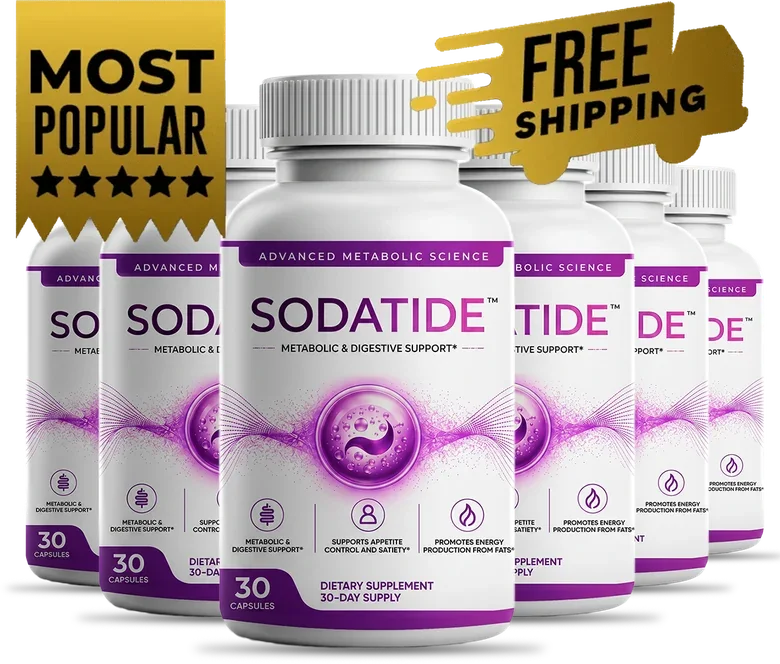
Product photography from SodaTide's own marketing pages. Promotional badges shown in the image are the seller's, not something we're endorsing.
- What it is: a one-capsule-per-day synbiotic — 211mg chicory root inulin, 100mg potato resistant starch, and a 36mg three-strain probiotic blend (Akkermansia muciniphila, Clostridium butyricum, Bifidobacterium infantis), 30 capsules per bottle.
- What isn't on the label: how much of the 36mg blend is actually Akkermansia versus the other two strains, and no published third-party test of a finished bottle.
- What we found checking the seller: a distributor name we couldn't verify as a registered business, at least a dozen duplicate marketing domains, a self-issued press release syndicated as if it were independent coverage, and a wide gap between the seller's own review claims and what an independent platform actually shows.
The biology first: why a specific gut bacterium gets research attention
Akkermansia muciniphila is a bacterium that lives in the mucus layer lining the gut and, unusually for a gut microbe, feeds on that mucus lining itself rather than on food residue. Over roughly the last ten years it's become one of the more closely studied single species in human microbiome research, largely because animal studies and a handful of small human trials have associated higher levels of it with a thicker, healthier mucus layer, markers tied to metabolic health, and better insulin sensitivity in some study populations. Chicory root inulin and resistant starch, the two non-probiotic ingredients on SodaTide's label, are both fibers that gut bacteria ferment into short-chain fatty acids — a process with its own body of research connecting it to gut-lining integrity and metabolic signaling.
None of that makes SodaTide's specific formula, dose, or delivery method a proven consumer product. The research behind Akkermansia muciniphila mostly involves pasteurized or lab-cultured strains studied under controlled conditions, sometimes in a form different from what's shelf-stable in a capsule sold at retail. A real mechanism existing in the literature is a different claim than a specific 36mg blend, undosed by strain, doing the same thing once it's swallowed.
The research interest in Akkermansia muciniphila is genuine and still active. What it doesn't tell you is how a specific commercial capsule performs, especially one that doesn't disclose how much of its probiotic blend is actually that strain versus the other two. A real mechanism and a verified product are two different questions, and SodaTide's label only lets you answer the first one.
What we found on the label itself
SodaTide's supplement facts panel, which we found repeated identically across every version of the product we checked, lists 211mg chicory root inulin, 100mg potato resistant starch, and a 36mg "three-strain probiotic blend" of Akkermansia muciniphila, Clostridium butyricum, and Bifidobacterium infantis, in a hypromellose (vegetarian) capsule with microcrystalline cellulose, magnesium stearate, and silica as fillers. One capsule per day, 30 capsules per bottle. The blend weight is given as a single combined number, not broken out per strain, and we couldn't locate a certificate of analysis or third-party viability test for a finished bottle anywhere.
The storefront footprint
Checking where SodaTide is actually sold turned up a wide spread of near-identical marketing sites rather than one storefront with a backup URL. Across our own search we counted at least twelve distinct domains running the same page template and the same formula — variations on the product name with letters doubled, hyphenated, or prefixed. The checkout flow, on every version we traced, routes through BuyGoods, a third-party checkout platform that states plainly on its own pages that acting as the payment processor isn't an endorsement, approval, or review of what it's processing. The distributor named on that checkout page is "Instituto Experience," listed in Lakeland, Florida; a separate resale page instead credits "Sodatide Research" as the brand behind the same product. We searched for Instituto Experience as a registered business and found no public match, so we can't confirm it's an accountable, findable company rather than a name printed on a checkout form.
A press release dressed as coverage
One layer we hadn't seen on this exact product before we looked closely: a press release issued directly by "SodaTide" through a commercial wire service, then republished word-for-word by several sites that read, at a glance, like independent outlets. The release itself carries the standard FDA disclaimer and reads as brand marketing once you check the byline, but its wire-service distribution means it now shows up in search results looking like syndicated news rather than the seller's own promotional copy. That's not illegal, and wire-distributed press releases are a normal marketing tool — but it's worth knowing that some of what looks like third-party coverage of SodaTide is the manufacturer's own writing wearing a news outlet's layout.
What independent reviews actually show
The seller's own marketing sites are inconsistent even with each other on this point: some show no review count at all, while outside reporting has documented other versions claiming a 4.9-out-of-5 average. What we could check independently told a different story. A supplement-focused review aggregator's own analysis placed the product at roughly 1.3 out of 5 based on outcomes actually reported by users. A Trustpilot listing tied to one checkout domain, which we pulled directly, shows 9 reviews averaging 2.3 out of 5 — a small sample, but an independently verifiable one, and nowhere close to the figures the marketing pages imply.
A supplement with real research behind one of its ingredients can still be sold by an operation whose own review numbers don't hold up to outside checking. Those are separate questions, and SodaTide is a case where the answers point in different directions.
Billing complaints and the pricing shown at checkout
A checkout page we reviewed states purchases are "a transparent one-time transaction with zero hidden rebills or subscriptions." That claim sits alongside a documented complaint pattern: a report to the Better Business Bureau's Scam Tracker describes a buyer who ordered six bottles through a social-media ad, was offered an upgrade, and received eighteen bottles they believed were counterfeit, for a reported loss of $641. A separate, independently reported complaint describes a single-bottle order being charged twice without authorization, with the buyer needing their bank to intervene after customer support didn't resolve it. We can't verify how common either experience is, but both are specific, sourced, and directly at odds with the "zero hidden rebills" language on the seller's own page.
On pricing, the checkout page we reviewed lists a "regular" reference price of $179 per bottle, scaled evenly across every tier ($358 struck through against a $158 total at the 2-bottle tier, $537 against $207 at 3 bottles, $1,074 against $294 at 6 bottles). To be precise about what we did and didn't find: the math on that reference price is internally consistent across tiers, which is different from what similar checks of this product have flagged elsewhere. What we couldn't find anywhere is any independent record that $179 was ever an actual price this product sold for — it functions as a comparison number set by the seller, not a documented former price.
A similarly-named listing that isn't the same thing
Separately from the direct-to-consumer product described above, marketplace listings on Amazon and eBay use the same or a near-identical "SodaTide" name, sold by different, unrelated sellers, in 60-capsule bottles (a two-capsule serving) rather than the 30-capsule, one-a-day bottle described here. We couldn't confirm whether these listings share the same three-strain formula. Treat them as a separate, unverified product line rather than confirmation of anything above.
Pricing, as the seller displays it
We aren't selling SodaTide through this page, and nothing here is monetized — this is only what the seller's own checkout shows, reproduced so the numbers above make sense in context.
$79/bottle — 2 bottles, 60-day supply, plus shipping
$69/bottle — 3 bottles, 90-day supply, free shipping
$49/bottle — 6 bottles, 180-day supply, free shipping
This is the seller's own checkout pricing, not an Amazon link. Modern Biology News doesn't process this purchase, doesn't control this pricing, and earns nothing from it.
A supplement built around the same research, with real label disclosure
If the biology above is what interests you, Codeage Akkermansia Muciniphila with Chicory Inulin is a standalone way to look at it without the storefront questions documented above. It isn't a copy of SodaTide's exact formula — it skips the potato resistant starch, Clostridium butyricum, and Bifidobacterium infantis entirely, and pairs a single, disclosed 100 million AFU dose of Akkermansia muciniphila with 435mg of chicory inulin per capsule, 90 capsules to a bottle. Disclosing an exact AFU count for one strain is more per-organism transparency than SodaTide's combined 36mg blend gives you for any of its three. Codeage is a supplement brand with a findable, ordinary company identity and listings across multiple established retailers, which is more than we could confirm for either name attached to SodaTide's checkout page.
See it on Amazon →As an Amazon Associate, Modern Biology News earns from qualifying purchases. This link opens a live Amazon search for this exact product, not one listing we control — prices and sellers may vary.
Questions we got asked directly
Does the Akkermansia muciniphila research mean SodaTide works?
It means the organism itself is a genuine, active area of gut-metabolism research. It doesn't mean this specific 36mg, three-strain, undosed-by-organism blend has been tested and shown to reproduce those results. Those are two different claims, and only the first one has real evidence behind it.
Is SodaTide a scam?
We can't speak to intent. What we documented — an unverifiable distributor name, a dozen-plus duplicate marketing sites, a self-issued press release distributed to look like independent coverage, review numbers that don't survive outside checking, and specific, sourced billing complaints that contradict the seller's own "no rebills" language — is the pattern we'd want a reader to weigh carefully before ordering.
Why link to a different product instead of SodaTide?
Because we couldn't verify who actually stands behind SodaTide's checkout page, and the marketplace listings using its name appear to be a different product entirely. Codeage's version of the same core ingredient comes with a company we could actually confirm exists.
SodaTide's own checkout and marketing pages, checked directly across multiple mirror domains, for label claims, pricing, and guarantee language. A supplement-review aggregator's independent scoring of reported outcomes. A live Trustpilot business listing tied to one checkout domain. A Better Business Bureau Scam Tracker report and a separately reported billing complaint. A wire-service press release issued under the SodaTide name and its republication across several outlets. Amazon and eBay marketplace listings referencing a similarly-named product with a different serving size. Codeage's own product labeling for the alternative discussed above. General background on Akkermansia muciniphila and dietary fiber fermentation draws on the broader gut-microbiome research literature summarized for a general audience, not any single study.
This article is for general educational purposes and is not intended to diagnose, treat, cure, or prevent any disease. It is not a substitute for professional medical advice. Talk to a healthcare provider before starting any new supplement, especially if you take prescription medication or manage an existing health condition. Statements about dietary supplements have not been evaluated by the Food and Drug Administration.